
High-Performance Slicer
KFT Food Machinery
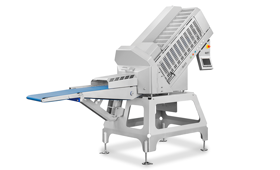
By synchronizing the control of 10-axis servos with high speed and precision, the system achieves high-precision cutting at up to 14 cuts per second while simplifying the network.
2026-10
Challenges Before Implementation
-
To maintain stable cutting accuracy even during high-speed operation, it was necessary to synchronize the 10 servo axes with high speed and high precision.
In food manufacturing environments, where long operating hours and frequent setup changes are common, stable performance is essential; therefore, it is important not only to operate at high speeds, but also to maintain stable, high-precision cutting even when running at maximum speed.
Since KFT’s slicer is a high-performance machine that uses 10 independent servo axes to perform up to 14 precision cuts per second, it was necessary to enable high-speed, deterministic communication between each component in order to synchronize the numerous axes with high precision.
-
Increasing Complexity of Control and Communication Systems
Because the system handles not only motion control but also multiple devices and systems —such as I/O, pneumatics, and safety systems—the communication architecture, wiring, and system integration tend to become complex, making it necessary to minimize the burden of setup and commissioning.
Benefits After Implementation
-
Achieves high-speed, high-precision multi-axis synchronization, improving productivity and reliability
Thanks to CC-Link IE TSN's gigabit bandwidth and stable, high-speed communication, multiple servo axes are synchronized in real time. This enables stable, high-precision cutting even at maximum speed, improving productivity and reliability.
It also helps reduce the risk of unexpected downtime and variations in machining results. -
Simplify network configuration and reduce wiring and setup time
CC-Link IE TSN allows real-time control data and diagnostic data to be handled on the same network due to the converged network architecture supported by TSN, enabling a simple communication architecture. This makes it possible to standardize communication architectures —including motion control, I/O, pneumatics, and safety systems—
thereby reducing the complexity of wiring and system integration and speeding up commissioning and setup.
